My research explores the rhetoric of infrastructures and procedures that shape information systems, particularly archives and digital collections. I develop mixed-method approaches to examine how data is conceived, organized, and deployed within these information systems to document the past, offering ways to address inequities through community-engaged projects. I contribute to the theoretical advancement of rhetorical historiography by applying digital methods to archival analysis, fostering publicly-engaged research that values community partners as co-producers, and developing pedagogical innovations in critical game studies and digital literacy.
Bridging Rhetorical Historiography and Critical Data Approaches
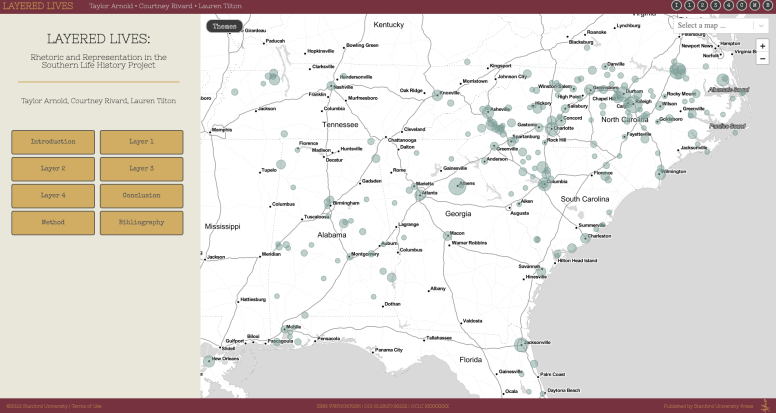
My first book, Layered Lives: Race and Representation in the Southern Life History Project (Stanford University Press, 2022), combines archival and quantitative methods to recover the history of the Southern Life Histories Project part of the Federal Writers’ Project during the 1930s. This innovative digital book combines maps, archival material, and data visualizations to demonstrate how gender and race informed the writing practices used to create the concept of “life histories,” which documented the lives of Southerners struggling to survive the Great Depression. The book was recognized with an Open Scholarship Award Honorable Mention from the Implementing New Knowledge Environments Partnership, and funded by the American Council of Learned Societies (ACLS) and the Institute for the Arts & Humanities at UNC-Chapel Hill.
Archival Rhetorics and Community-engaged Methods
Archival Structures and Federal Recognition: Through work with the Pointe-au-Chien and the Isle de Jean Charles Band of Biloxi-Chitimacha-Choctaw-Muskogee, two Native American communities near the Gulf Coast of Louisiana navigating the federal recognition process, I demonstrate how academics can work with indigenous communities to address inequities in archival structures. Obtaining federal recognition as ‘Indian tribes’ requires communities to prove continuous political existence from first European contact to the present—an effort that demands extensive archival research across scattered national, state, and private collections. The process often spans decades, costs millions, and rarely results in success. Because many archives privilege academic access, I used my position as a Ph.D. student and then faculty member to help retrieve materials on behalf of the tribes.
At the request of the Pointe-au-Chien and Isle de Jean Charles communities, I published articles about this work in Settler Colonial Studies (2015) and Rhetoric Review (2019) that expose how data structures within archival systems—through keywords, cataloging, and description—impact how evidence is conceived within the federal recognition process. These articles serve as evidence of the tribes’ existence according to the rules that govern the federal recognition process, and can, therefore, help their case. This absurd situation in which an academic outside the tribe has the power to render evidentiary existence demonstrates the profound inequities in the recognition process and the role that community-centered research methods can play as a first step in addressing them.
Wikipedia, Oral History Archives, and African American History in Chapel Hill: In 2022, I launched From the Rock Wall to Wikipedia, a collaboration among my undergraduate Rhetoric of Data (ENGL 114) course, the DLC lab, and the Marion Cheek Jackson Center, which documents the history of Chapel Hill’s African American communities through its From the Rock Wall oral history project. Centered on community needs and data literacy, the project expands the reach of these histories by developing Wikipedia and Wikidata pages for sites selected by the Jackson Center—leveraging Wikipedia’s influence in search engines and large language models. A forthcoming article in Digital Humanities Quarterly that I co-author with students and Jackson Center staff details how this model bridges digital humanities and data literacy to address structural inequities in online knowledge systems.
Forever Chemicals in North Carolina: A Story Archive: Moving from an analysis of archival rhetorics to collaborative methods to produce an oral history archive, I launched a partnership in 2022 between the DLC lab and Health Humanities (HHIVE) lab at UNC to document stories of those affected by PFAS (per- and polyfluoroalkyl substances) contamination. PFAS are widely used chemicals in non-stick and water resistant materials linked to cancer, thyroid and kidney disease, and decreased fertility. North Carolina faces widespread contamination, yet humanistic studies on PFAS remain scarce. Forever Chemicals in North Carolina: A Story Archive addresses this gap by using oral history as a method to better understand how individual community members in North Carolina understand PFAS exposure, how they connect PFAS to their local environment and community, and what motivates individuals to take action in response to these exposures.
Pedagogical Infrastructures of Critical Game Studies
Related to my interests in the rhetorics of infrastructure and procedures is a new program in Critical Game Studies (CGS) that I founded in 2019 through my role as Director of the DLC lab. Over the past two decades, a growing area of scholarship has developed to demonstrate the ways that games shape cultural production and are a dominant mode of storytelling and constitute a distinct form of multimodal composition combining audio, text, visuals, mechanics, and embodied performance that offer new ways to teaching writing. While scholars have presented assignments and lesson plans on using games in a single class, there has not been sufficient examination of how to enact playful pedagogies at a program level, particularly regarding necessary infrastructure such as technology, physical equipment, versatile furniture, dedicated space, trained instructors.
To address this need, I initiated and led the development of Critical Game Studies Program with the Greenlaw Gameroom, an interactive game-based classroom (the first of its kind at UNC), as its cornerstone. Funded by the NEH and a partnership between Lenovo and UNC’s Center for Faculty Excellence, this interactive game-based classroom enables a new type of pedagogy, collaborative close play, that I developed in collaboration with graduate students in the game studies program. Students overcome the tension between the immersiveness of games and the distance required for critical analysis by playing in community, cycling between the roles of player, advisor, researcher, and notetaker. This pedagogical approach and the development of the Gameroom is detailed in a forthcoming article, “A Room for Play: The Infrastructure of Game Pedagogy.”
Future Directions: An Exploration of the Rise of Crisis Collecting and Disaster Archives
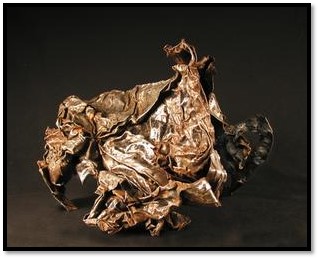
In my next project (Crisis Collecting: Rhetoric, Affect, and Archives in the 21st Century), I investigate new methods deployed by many U.S. historical institutions to collect and display materials relating to contemporary disasters. These new methods, which I define as “disaster archiving,” began with efforts to collect material relating to September 11, 2001. Disaster archiving contains four key elements: (1) immediate collection of physical materials, rather than the previous methodological tenet that called for significant time and distance before initiating collection procedures, (2) preservation of objects in perpetual destruction to maintain their authenticity, (3) a focus on stories rather than historical context, and (4) digital collection of born-digital materials that demonstrate the general population’s thoughts and feelings relating to the event including emails and digital material to a scale never before possible. Using theories on archival rhetorics, I analyze the impact of this new method of collecting ‘history-in-the-making’ on notions of race, gender, and national belonging in times of disaster by focusing on case examples from archives created to remember September 11, 2001, Hurricane Katrina, and the Covid-19 Pandemic.
 Courtney Rivard